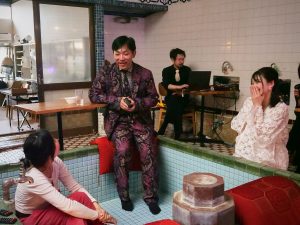
Young Japanese women find the corporate ladder hard to climb. (Photo by Ángeles Maku.}
Text and photo by Ángeles Maku
Interpretation by Than Shue Jing
It’s 1986, and Japan’s Equal Employment Opportunity Law has just passed, creating protections for women workers from gender-based discrimination in the areas of promotion, recruitment and hiring.
Atsuko Fujino enters the workforce. She has graduated from college and works as a civil servant, yet despite her role on paper, she is expected to get tea for her male colleagues. She is married to a Japanese man working for a demanding company. For his job, he is expected to relocate frequently. Even in graduate school, she fulfills the role of a good wife and follows her husband through these transfers.
This was the story of Fujino in her youth. And decades later, it remains typical for young Japanese women with aspirations for a professional career.
Fujino eventually returned to graduate school, acquired a doctoral degree in economics and another in sociology, and is now a faculty supervisor at Kyoto Sangyo University, specializing in population and labor studies in the Sociology Department. She is a published author. She has remarried — this time, to a Frenchman — and pushes for feminism through her work and daily life.
Her story illustrates the barriers faced by women in Japan, who are forced to take on ample responsibilities, all while being undervalued regardless of their qualifications. For young Japanese women today, it is difficult to follow in her footsteps and overcome similar obstacles.
Womanhood as a global experience cannot be defined easily, with cultural impositions of varying intensity impacting societal roles differently. For Fujino, the life of a woman in Japan presents itself as misogynistic and restrictive, yet certain aspects of this society allow for a kind of newfound flexibility for some foreigners. “For the safety [aspect], it’s worth living here,” says Happy Ayuni, 26, an international student from Indonesia.

Ayuni is a student at Kyoto University of Foreign Studies. Born and raised in Bali, she grew up with the expectation to prioritize marriage over education. In Japan, she finds the country “is much kinder to women, but still has a long way to go.” Especially in STEM fields, Ayuni finds that women are only supported in education through high school. Once they get to college, the support ends, unless they are pursuing female-dominated fields, such as nursing, arts, or cosmetics. “It’s less like breaking a glass ceiling; for us, the ceiling’s made of concrete.”
A declining birth rate in Japan raises societal pressure to get married and have children, but the worsening economy has forced many young people to optimize survival, often by taking on multiple part-time jobs just to make ends meet. Ayuni said Japan’s high unemployment for young people and Tokyo-centric job market make it difficult for them to start any part of their lives beyond finding security, particularly for women in a male-dominated employment system.
“Love is good, but money’s better,” said Haruka Hoshina, 23. As a student at the same institution as Ayuni, Hoshina works to support herself. “I’m too busy with work, so the hassle of dealing with a relationship feels bothersome.” Both students discussed their frustrations with partners unwilling to take on the responsibility for homemaking because of cultural norms. “Women are expected to do everything — to pick the restaurant, to raise the kids, and still to go to work,” said Hoshina. “The man, he just works.”
In the Shōwa period (1926-1989), the father took on more authority over the family unit, according to Fujino. In Ayuni’s current experience, fathers prioritize corporate life, only having weekends to share with their children, while mothers must take on all child-rearing and other homemaking tasks, but also work outside the home. The overwhelming responsibility to serve, work, and care for the family unit continues to be pushed onto the woman.
Hoshina agreed that women are still at a disadvantage, but she said there has been some progress. “This generation is not so bad to women,” she said. “It’s better than in the past.”
Japan lags behind some other countries by many measures. According to the World Bank’s gender data landscape, as of 2022, women held 13.30% of senior and middle management positions in Japan, while in the United States, they held 44.3%, and in Iceland, they held 37.30%.
Sanae Takaichi took office as Japan’s first female prime minister in 2025, giving a symbolic boost to women’s empowerment. However, her politics lean toward conservatism, and she has not emphasized gender equality. She’s not getting much pressure from young women. “Young people, they’re not activists,” said Fujino.
Hoshina agreed that she has never seen young people protest throughout her time in Kyoto.
But Ayuni said there may be a difference in the number of demonstrations for gender equality between the country’s former and current capital cities. “In Tokyo, more people are aware of it, and actually organize something around it,” she said. “In Kyoto, I haven’t seen one.”
The strict work culture in Japan may take away much of the ambition for youth to demand a better future for themselves, but that doesn’t mean Japanese women don’t dream of a better society. “Young people today lack drive, I think,” she said. “We don’t want to work, don’t want to marry. We just want to be free.”