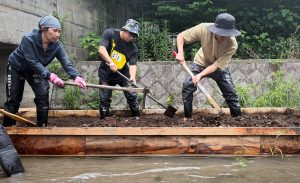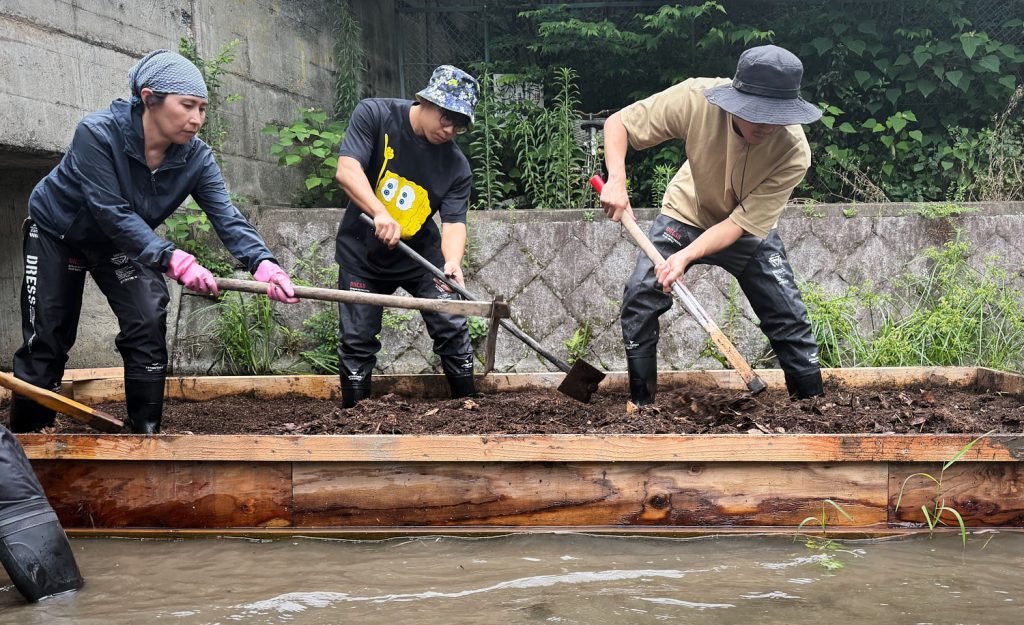
Three people from a project taking placing at Kyoto University School of the arts hoeing the composted soil and mixing it with the previous soil before planting violet plants. The planter sits on a sandbank in the river adjacent the school. (Photo by Katherine Istomin.)
Text and photos by Katherine Istomin
Interpretation by Luna Saito, Masa Kawamukai and Madoka Chase Onizuka
藝術. The kanji for “arts.” The first part refers to planting and cultivating. The latter represents a method or technique. Together they come to describe the Kyoto City University of Arts, and University President Toru Koyamada’s promise of a growing education of the arts.
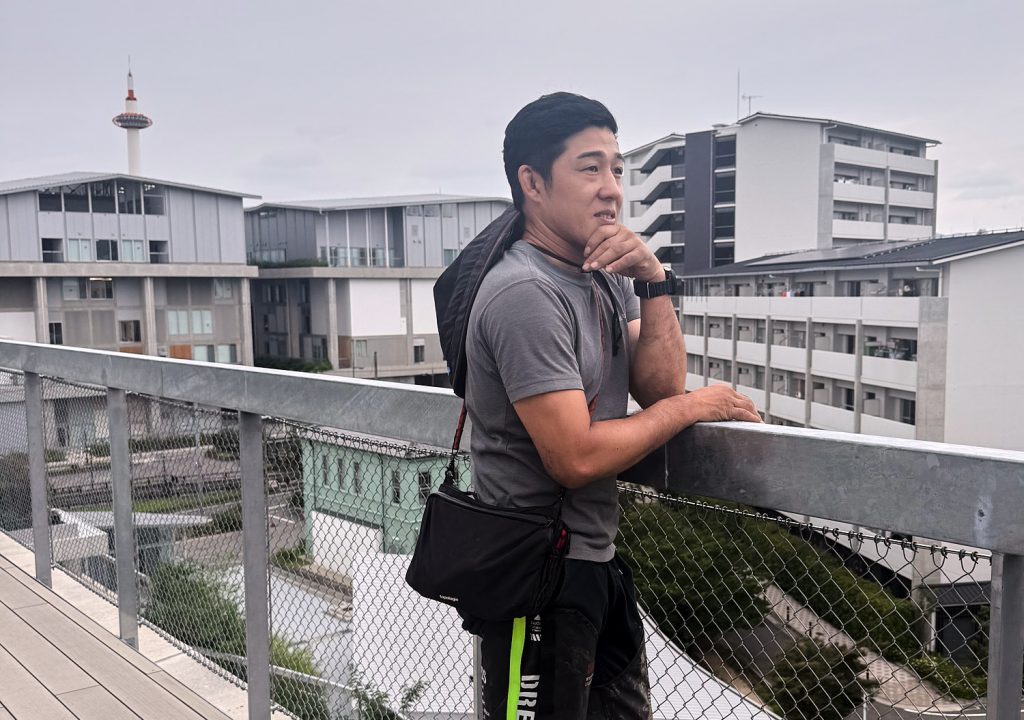
Three years ago, the Kyoto City University of Arts relocated near the Kyoto City Station — a move that was a decade in the making.
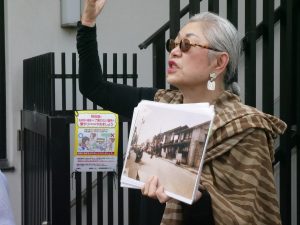
For 10 years, administrators planned the campus layout, the buildings and the logistics of uprooting an entire university from a tranquil, rural setting to the city center. The incoming students felt that disruption deeply. Beyond the practical adjustment, they were quietly afraid of their new surroundings – a neighborhood long stigmatized, streets that were shaped by an aging population that carried a complicated history filled with prejudice and unspoken stories. The fear ran in both directions, said Masayo Fujio of Suijin Hasshin Jikkō Iinkai, a human rights non-profit that serves the neighborhood.
Not used to a younger generation, the local community took some time to adjust to the bustling university campus that had relocated to its quiet city neighborhood, Fujio explained. Streets that once had few pedestrians echoed with loud laughter and bike bells ringing. Buildings that once used to be shops or homes of friends were now art studios and cafeterias.
“We were here first; Kyoto Station came later,” Fujio explained.
As the university entered the Kyoto Station area, it made sure right away to establish to the locals that it wasn’t trying to take over. Koyamada had one central question in mind: How should we plan for a place with a deep and dark history they did not fully understand, Koyamada explained.
“To understand the warmth and kindness of the neighborhood, we must get connected with them,” he said. So, for three consecutive months before the opening, Koyamada and other school officials planned weekend bonfires on the incoming university’s campus to welcome the local community.
The locals were hesitant at first. Yet, curiosity and the university’s intentional open campus prevailed. Residents began to wander in, taking a seat at the university to rest and strolling through to look at the students’ projects displayed in the windows. What started as a casual shortcut on the way home from errands soon became a destination in its own right. Students would eagerly show off their artwork to the local residents. The elders who had once viewed the university with suspicion now started to feel a deeper connection with the school.
“The view has completely changed,” Fujio reflected, “partly because of these activities.”
And that’s just how those relationships came to be – natural.
Koyamada explained how the programs are usually run by staff independently to create an environment of eager students with their own style and dedication.
“We want to have lots of people doing little programs,” Koyamada said, “It’s better to make connections.”
This is exactly what Associate Professor Ryuichiro Ando did.
Ando noticed that when the river was getting managed by the city, the ecosystem was often overlooked. Sandbanks were destroyed, species were getting sick. Seeing this, Ando and six students came together to ask the local municipality if they could take care of the river, preserving nature and dispersing the taxpayer money to go elsewhere.
On top of creating a blooming environment, “it gives students the opportunity to open their eyes and make art,” Ando said. He added that to create art focused on cultural anthropology, “you need time to understand.”
Since their start in 2023, the river clean up has taken a creative turn.
Maya Mima, a former student and program member, applied what she learned in class to a real-life situation. Studying dyes of textiles and the local neighborhood, she wanted to merge her two passions together.
Mima helped transform the river cleanup into a research project on indigo and textile dyes. With the help of around 20 other members, mostly full-time faculty, alumni and current students, they built an indigo farm on the sandbanks of the river.
The members create compost from the leftover sand of the temples and the plants they had cut from maintaining the river and test the best conditions for the indigo to grow. Once harvested, this indigo is used to make dyes for the textiles that the students use in class.
What makes the indigo project even more significant is that this practice was used in the area historically. Mima carries this history forward by listening to the stories of local residents and weaving them into tapestries that preserve their memories and culture, using dyes sourced from the surrounding landscape. These little details all come together to tell a story of a decreasing population.
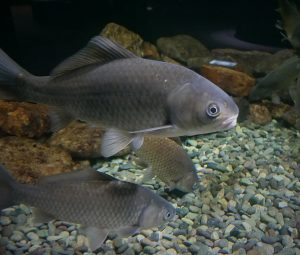
Additionally, with the constant maintenance of the river for the indigo, the eels that once fled their homes have returned. Almost like the city itself, with the addition of the university students, the neighborhood can be restored once more. “We need to understand each other, to see in which direction we go next,” Ando explained, emphasizing the need to promote local culture.
This sense of community extends past the riverbank. Koyamada has proposed what he calls a 100-year forest — a deliberate effort to let the land around the campus mature, rather than just filling it with short-term buildings.
“An antithesis to development,” he described it. Rather than filling the space with structures, he envisions travelers stepping off at Kyoto Station and being greeted first by trees, then the river, then the temples and mountains beyond.
“It creates a waveflow for people to go,” he said.
The proposal rests on the three principles. Firstly, the understanding that the university is entering into a relationship with the environment. This underscores that the land should not be centered around human need, but rather an accompaniment to the ecosystem. Secondly, to achieve this harmony, it is utterly important to learn from the time of the land. To understand the history and culture of it is the only way to preserve it. And lastly, to acknowledge that they are just temporarily handling the land until the next generation.
With this, Koyomada knows it must take time. He is careful not to rush it. The official proposal will be submitted to Kyoto City this autumn, when he’ll need to convince city officials that subtracting development can actually produce more richness. The response has been largely positive, though the negotiation continues.
“The city officials expected new collaboration but they didn’t know in what ways,” Koyomada explained. While the officials were unsure, he said, they knew an art university could connect with the community.
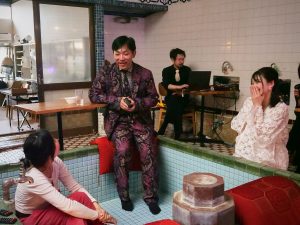
Art bloomed in the streets. Locals hosted nighttime performances, hung student art on their walls and filled their spaces with jazz. In turn, the students started to go out into the neighborhood, not just to observe, but to participate. Slowly, but surely, the blend of culture and history came together.
What first began as an uneasy coexistence soon became a genuine connection between locals and students. It was an exchange between generations, an exchange of institution and community and between a rapidly changing city and the people who remember what it once used to be like.
Fujio described how the student drawings serve as archives for the city facing transformation, capturing streetscapes, storefronts and faces that will soon be changed. Without them, the area and those around them would disappear without record.
Today the elderly residents act as family for the students. Often getting categorized as aunties and uncles, they slip them snacks on their way to class, linger to ask about their projects and open their homes and hearts to the students.
Fujio, who watched this transformation of the local area unfold before her, reflects upon the rocky beginning.
“Only having one opinion would be dangerous,” she said. The integration has worked, she believes, because both sides remained willing to be changed by the other.
Fujio said the collaboration could not have happened in just any neighborhood with just any university. It took one where students were taught to express themselves, one where creativity, blending and combining foreign objects was encouraged.
“With art, there is no wall,” she said. “Yet with art, you can overcome any wall.”