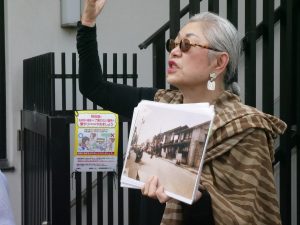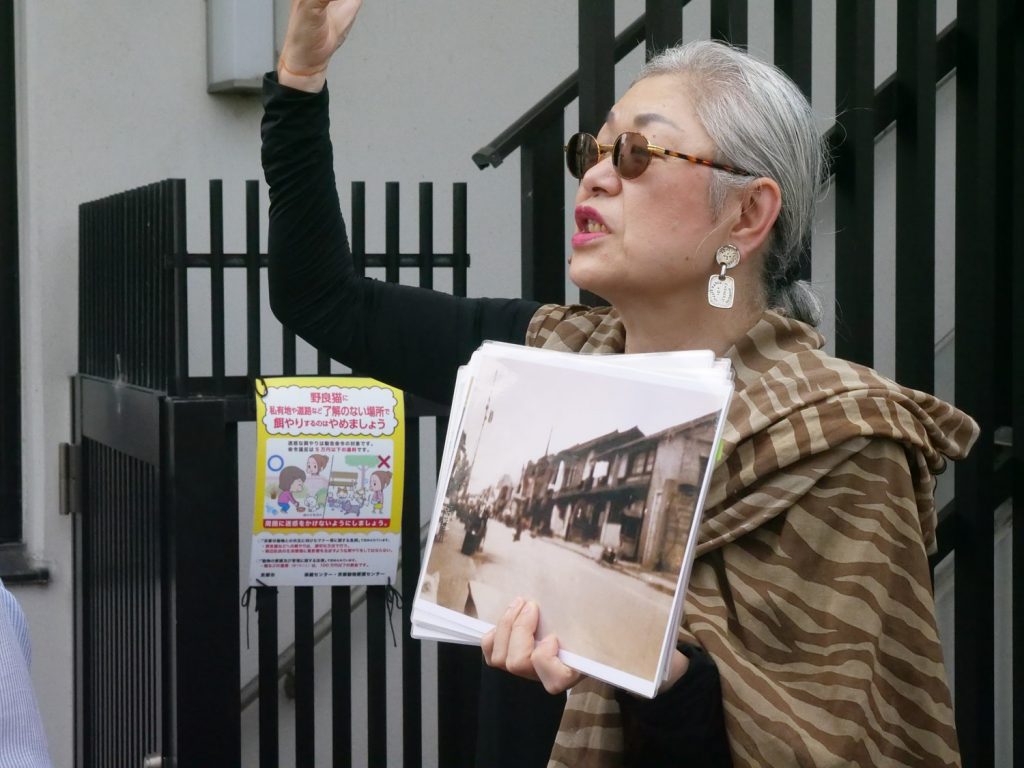
Masayo Fujio leads a tour of the Sujin neighborhood where she grew up. /Photo by Andrew Smith
Text by Anthony Clauson
Photos by Anthony Clauson and Andrew Smith
Interpretation by Luna Saito, Masa Kawamukai and Madoka Chase Onizuka
Content warning: This article contains discussion of suicide. See resources at the bottom of the article.
Masayo Fujio quickened her pace in the bookstore.
Books about Burakumin, Japan’s historically discriminated against community, stared at her from the shelf. She wanted to walk closer, to stop and read the books for herself, and learn more about why the Buraku were treated unfairly. But the thought of people seeing her read those books forced her feet to carry her away.
Fujio grew up in the Sujin district of Kyoto. Sujin, which sits along the Kamo River, is a five-minute walk from the bustling Kyoto Station. Marked by towering white and beige apartment complexes, Sujin is dotted with green, with overgrown vacant lots and lush riverbanks.
The neighborhood has changed drastically over its long history. Originally settled by leatherworkers who utilized the river for tanning hides, the area was affluent but segregated from the rest of Kyoto. In part due to leatherworking’s association with death, the people of Sujin, and their descendants like Fujio, were considered unclean.
Yoshisa Sakata, a schoolteacher who has researched Buraku communities, explained that the segregation of Buraku from the rest of society was woven into folklore that reinforced the discrimination. People from Buraku-associated areas like Sujin were considered the lowest tier of the caste system until it was outlawed in 1871.
While the caste system was abolished, prejudice continued, according to Sakata. Wealthy families were able to leave areas like Sujin, and the poor were forced into slums.
Following World War II, Japan underwent a period of rapid economic growth, and from 1969 to 2002, the Japanese government worked to develop historically Buraku areas.
Kenzo Tomonaga, director of the Buraku Liberation and Human Rights Research Institute, gave a presentation on the history of Buraku reform policy in Gwangju Metropolitan City in Korea on November 11, 2010.
Tomonaga said in his presentation that government policy “resulted in the significant improvement of the living environment of the Buraku areas. There were also other achievements, such as the increase in the rate of Buraku children going to senior high school.”
Policies benefiting people with Buraku heritage officially ended in 2002, partly due to public perception that Buraku people were receiving unwarranted government assistance, according to Sakata.
The improved living conditions came to Sujin by way of city-owned apartments exclusively for original Sujin residents and their families. Since the housing was built for the people of Sujin, people from other parts of the city cannot move in unless they live with a direct relative or marry a resident of Sujin.
Sujin had a community of over 9,000 residents in 1960, but as of the last census in 2020, the population decreased to 1,300, according to Fujio. Fujio suspects the current population is under 1,000.
Public perception of Sujin is not as harsh as it once was, but one realm where it still lives on is in marriage.
At 15 years old, Fujio met the man she would date until she was 30. The man was also from Sujin, but his mother wanted him to marry into higher status. After they broke up, Fujio felt alone and isolated. She moved away from Sujin and did her best to hide her heritage.
The weight of her ancestry and the isolation she felt after losing her longtime boyfriend pushed Fujio to attempt suicide. Fujio said someone saved her from the attempt.
“I sacrificed myself so that people would see my body and understand that discrimination kills,” Fujio said. “I think it was an act of making myself a visible example.”
Fujio’s story is not uncommon. Kayoko Sakai of the Buraku Liberation Center said in her time working for the organization, she has heard of many people dying by suicide because of marriage discrimination.
Growing up, Fujio’s parents never told her why she was discriminated against or what Buraku was. Today, with less obvious discrimination, Sakai said many people don’t realize they have Buraku roots until they share their family history for a prospective marriage.
Sakai said she has heard of several suicides after marriages fail. The suicide rate in Japan is 12.2 people per 100,000 population, according to 2019 estimates from the World Health Organization. Japan is over the global standard of nine people per 100,000 population set by the WHO.
The stigma surrounding marrying someone with a Buraku bloodline has contributed to the steadily declining Sujin population.
Due to Sujin’s proximity to Kyoto Station, the main train station connecting Kyoto to the rest of Japan, the area has become prime real estate for city development. Kyoto City University of Arts moved into Sujin in 2023, heralding the start of the area’s most recent phase of gentrification.
Kunimitsu Imai, chief global policy officer for the city of Kyoto, said in an email, “The relocation of the Kyoto City University of Arts, alongside the active expansion of private-sector initiatives such as teamLab, is transforming the district’s image and creating new vibrancy and appeal.”
Ryuichiro Ando, who teaches about textiles at Kyoto City University of Arts, grew up across the Kamo River from Sujin. Ando said he has watched Sujin transform from a dangerous place his parents warned him to stay away from to a safe community where he now works.
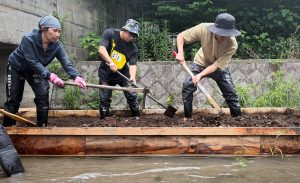
Ando started an effort to clean up the Takase River, a canal of the Kamo River. The clean-up project evolved into an experiment in growing indigo in garden beds placed in the river. Indigo was traditionally grown around Sujin.
Ando said he sees his efforts working with the river as a way to connect with the local residents and give them a positive impression of the changes coming to their community.
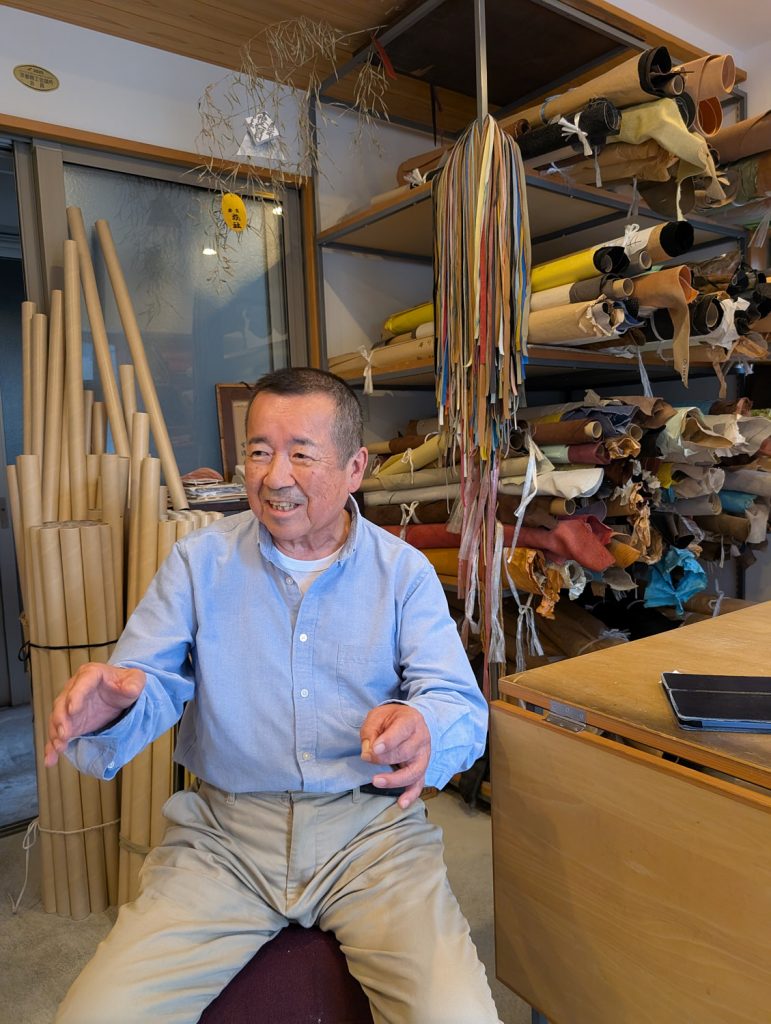
Nubuo Nishikawa, a leather worker, is 72 years old and has lived in Sujin his whole life. Nishikawa currently owns Nishikawa Ya Shoten, a leather shop that his parents opened in the late 1940s. Nishikawa Ya Shoten is the last remaining leather shop in an area that was once defined by the trade.
Sitting in his shop, rolls of leather stacked to the ceiling on shelves behind him, Nishikawa said he has seen his community change a lot over the years. His old home and the location of his leather shop were both where Kyoto City University of Arts currently sits.
Nishikawa said he had no problem moving and got a “good deal” on his new home and shop.
“We have to accept that some things change with time,” Nishikawa said.
Nishikawa said that while change scares him, he can’t bear to think about any negative changes to Sujin.
“I don’t think I have such negative views of Sujin anymore,” Nishikawa said. “The area has been redeveloped, and many of the houses have been rebuilt. Maybe some people still feel that way, but I don’t—this is my hometown.”
Unlike Nishikawa, Fujio faced the negative realities of her situation head-on. After her suicide attempt, Fujio said she felt like she was living a “life without soul.”
“I didn’t have the knowledge to find the answer, and that made me so angry,” Fujio said.
When she was 47 years old, Fujio stopped hiding her past and started studying human rights and Buraku discrimination. Now, at 69, Fujio has dedicated herself to advocating for Sujin and being an educator herself on Buraku issues.
“Until people realize that way of thinking is wrong,” Fujio said, “discrimination won’t end.”
If you or someone you know is struggling with suicidal thoughts, consult these resources:
In Japan: https://telljp.com/lifeline/
In the United States: https://988lifeline.org/