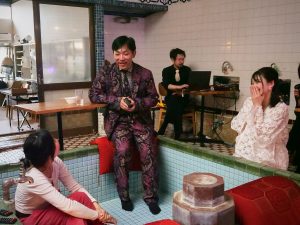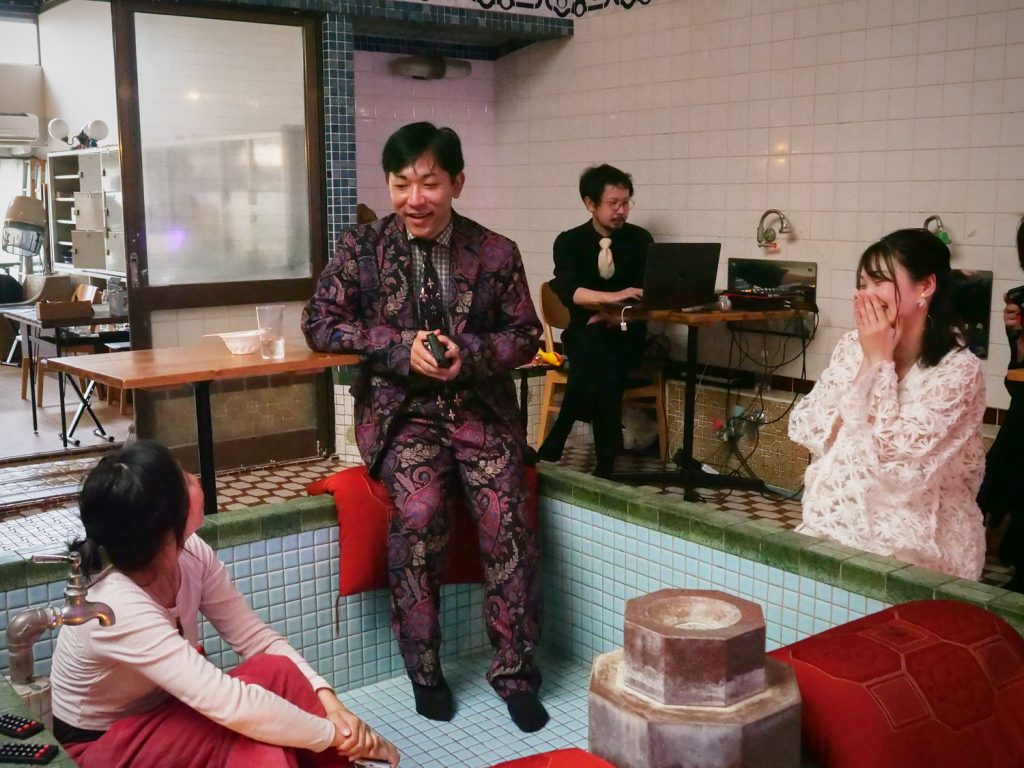
Musician Furan Necomaru (right) interacts with guests before the performance.
Text and photos by Andrew Smith
In an old Kyoto bathhouse, the tiled bathing rooms were once filled with the steam of hot water and conversation. Now, the rooms echo with live music while audience members sip drinks in the old repurposed bathtubs.
Walking in feels much like entering a traditional sentō – pay at the front, change into slippers and head to the tiled baths. But instead of soaking, guests come to jam out to live music.
The bathhouse’s former men’s section now serves as the concert venue, while the women’s side has been converted into a bar and restaurant.
Sentōs are traditional Japanese public bathhouses. Dating back to the 6th century, they gained popularity in the Edo period (1603–1868) as a place to bathe, socialize and relax in steamy hot water.
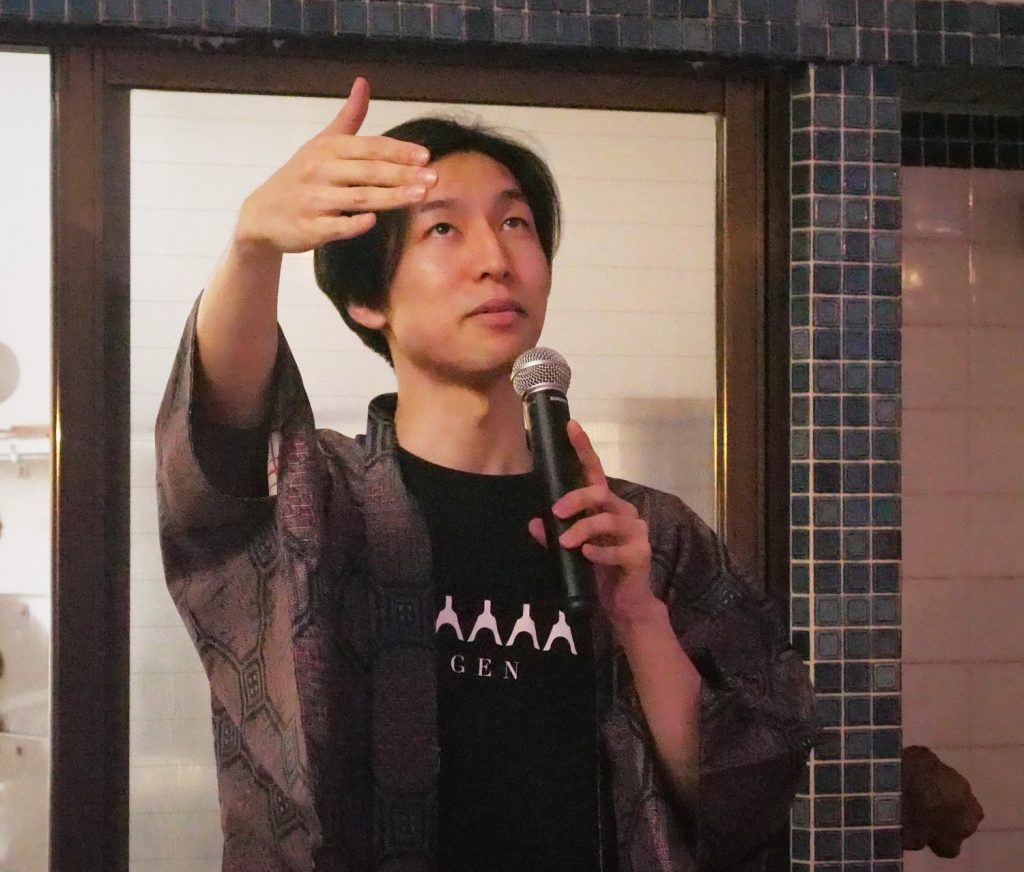
“Before, people in Japan used to come to sentōs because they didn’t have baths in their homes,” said 30-year-old Shohei Higashi, who rented out the old bathhouse after it was decommissioned as a sentō and turned it into a concert venue for an evening.
For centuries, many Japanese homes lacked private bathing facilities, making neighborhood sentōs an essential part of everyday life. As private bathrooms became a standard feature of Japanese homes in the 1960s, the neighborhood sentō gradually lost its essential role, contributing to the steady decline of public bathhouses across Kyoto.
In the years after World War II, Kyoto had hundreds of sentōs, according to government records. Today, there are only 76 public sentōs listed on the website of the Kyoto Prefectural Cooperative of Public Bath-house Operators.
Another reason why sentōs have declined so rapidly is that they cost a lot to maintain; that’s become an increasing challenge as fuel prices have risen.
Higashi, a Japanese musician and Kyoto resident, organized the music event as a way to preserve Kyoto’s culture while adapting it to modern times.
“Places like these are rare nowadays,” said Higashi. “They’re disappearing.”
After moving to Kyoto from Tokyo in 2020, Higashi asked the sentō’s manager for permission to leave flyers for a concert he was organizing. The manager, interested in the event, offered to let him start hosting events at the sentō.
Another reason why sentōs have declined so rapidly is that they cost a lot to maintain; that’s become an increasing challenge as fuel prices have risen.
In addition to communal bathing, sentōs provided a place for people to gather. Higashi is trying to at least bring that part of the sentō experience back with his musical performances in the former bathhouse.
“A bathhouse has a unique sound and echo, quite different from a regular concert hall,” Higashi said. “The sound of traditional Japanese instruments can be experienced in a more memorable way.”
Musicians who performed at the sentō in June combined traditional Japanese instruments like the koto with modern ones like the keyboard, as audience members sat around the former bathing area, now decorated with lights and cushions inside empty bathtubs.
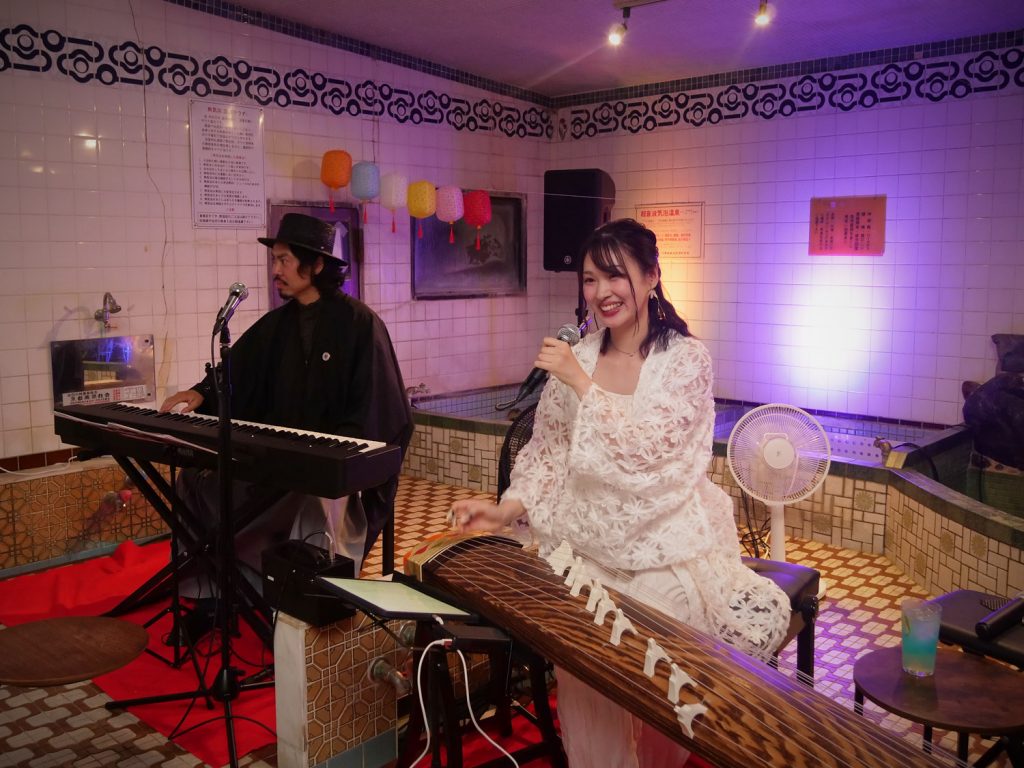
Ichi Kazuhiro, the artist who played the keyboard at the sentō, has been performing around Japan and in the United States for 20 years.
“Playing at the sentō was a very special experience,” Kazuhiro said. “The atmosphere inspired me and gave me many ideas for my keyboard playing.”
The bathhouse Higashi rented close to Kujo station is the only one in Kyoto doing regular performances with wagakki, traditional Japanese instruments.
“As far as I know, this kind of regular wagakki performance is unique to this bathhouse,” he said.
For Higashi, who plays traditional instruments such as the koto and shamisen, the bathhouse’s history gives the venue a distinctly Kyoto character.
The event is a first of many, according to Higashi.
“I’m planning monthly performances here for now,” he said. “Hopefully with more funding we can make them more frequent in the future.”
The next performance at the sentō will be on July 25.