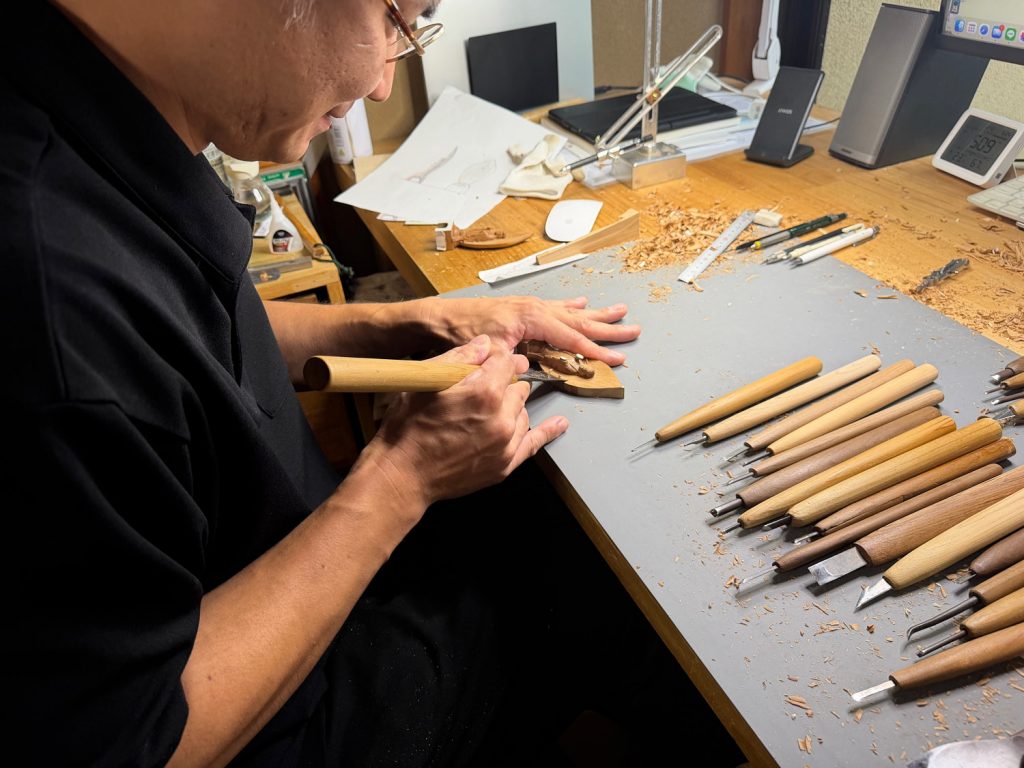
Tomoya Yokooji carves a miniature Buddha statue out of sandalwood in his home workshop in Kyoto. Photo by Emma Cooney
Text and photos by Emma Cooney
Interpretation by Luna Saito
In a house that smells like lumber, Hitomi Shiotani sits on her knees, hunched over as she delicately carves lines into a piece commissioned by a local Kyoto temple. Wood shavings are swept into piles on tatami mat-covered floors, stuck to her socks, and strewn on just about every surface of the workshop.
While she works on smaller decorative pieces, Tomoya Yokooji, Shiotani’s sensei, carves out the face of a Buddha on the other side of the room.
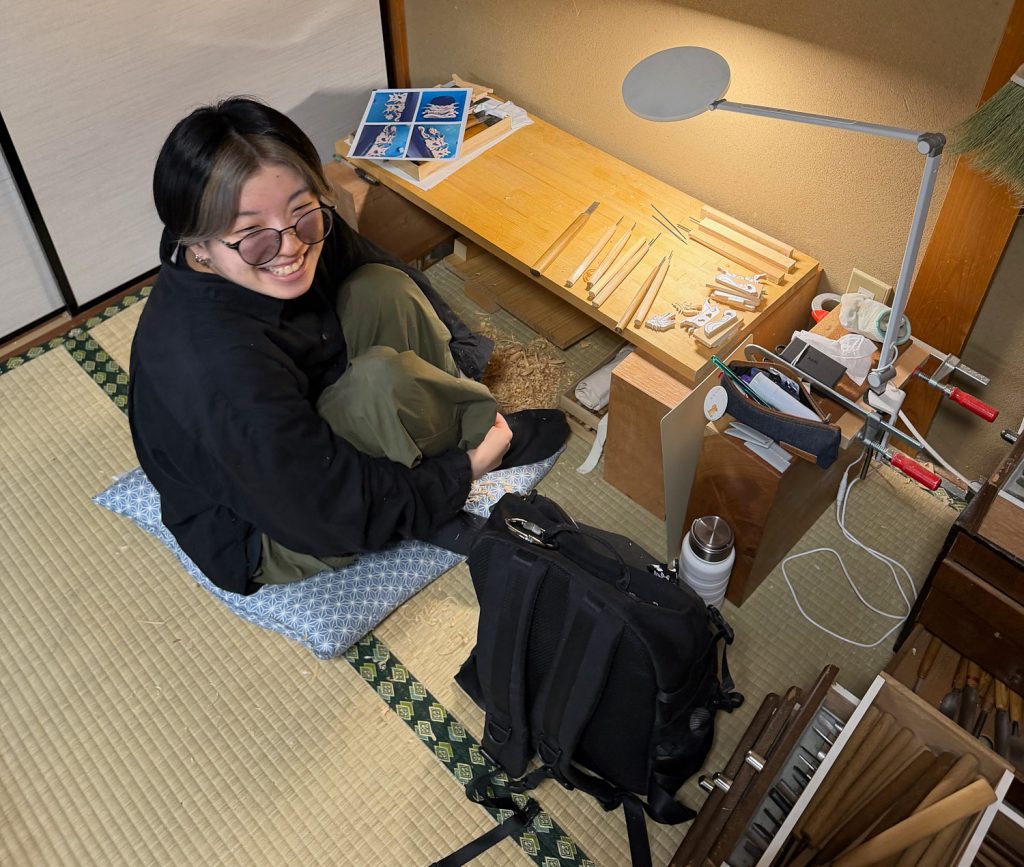
Shiotani, 22, is part of a new but shrinking generation of artisans who are carrying on Japanese traditional crafts. She works at Wood Sculptor Yokooji, a company with four workers, which operates out of the home of Yokooji and his wife and fellow artisan, Nobuko.
“I think traditional crafts are becoming more difficult to sustain,” Yokooji says. “Fewer people want to do this work, and fewer people even know these skills exist, so there’s less demand for them. That’s why I think it’s important for craftspeople to share and promote what they do.”
According to the World Economic Forum, the number of Japanese artisans declined from over 280,000 in 1983 to around 60,000 in 2016, a 75% drop.
Traditional Japanese crafts are at risk of dying out in a constantly modernizing Japan, but Kyoto continues as the “center of Buddhist art,” Yokooji explained.
Shiotani said she could only come to Kyoto to learn to create these specific Buddhist wood carvings. She spent four years at a specialized university for mokuchokoku, traditional Japanese wood carving.
In the past, teams of as many as 30 people might have worked on a project, Shiotani said. Now, one or two people typically work on a piece.
“I think wanting to carry on someone else’s passion is something universal,” Kokooji said. “That’s how these traditions have been passed down, and I hope we can do the same.”
Both Shiotani and Yokooji spoke about childhood memories that inspired their love for butsuzo, Japanese Buddhist wood carving.
“My dad was an ordinary office worker, but he loved DIY projects, so there were always carving tools around the house,” Yokooji said. “I used to play with them like they were toys.”
On a school trip to Nikko to see local temples, Yokooji said, “I was really moved by the carvings and decorations. That was where it all started for me. I’ve always loved the atmosphere of temples and grew up feeling close to them.”
Similarly, Hitomi recounted her grandfather’s hobby of making butsuzo and how her grandparents’ house was filled with decorative pieces.
They both expressed that as they sit in their workshop, carving out intricate designs into various types of wood, they feel as though they are meditating.
For the past three months, Hitomi has been demonstrating her work at the Kyoto Museum of Crafts and Design. But, a greater question lingers: How will Kyoto get more young people to carry on these traditional arts?
Masaki Higashimura, senior advisor to the Kyoto Museum of Crafts and Design, said that one of the museum’s priorities is to engage younger generations through education, experience and merchandising.
If younger people buy work at the museum and incorporate it into their daily lives, the traditional crafts will live on, Higashimura said. Kyoto students have free access to the Kyoto Museum of Crafts and Design, and the museum itself donates picture books about crafts to local elementary schools.
Challenges persist for artisans: deforestation causing material shortages, rising tool prices, fuel costs and job scarcity. Hitomiexplained that fewer people nowadays are funding temples, which in turn means artisans have less work.
While she said she doesn’t believe the Buddhist statues will ever completely vanish, some of the tools used to create them may. “The smaller tools are declining in demand,” she said. “They’re increasing the price of the tools.”
Yokooji said there are fewer artisans nowadays who even know how to make the carving tools. The Buddhist statues would not exist without every distinct artisan and their niche craft. To make one piece, specialty craftsmen need to work together.
While traditional crafts exist all over Japan, Hitomi and Yokooji both ended up in Kyoto for the same reason: the city’s industry is the biggest and most abundant, and many artisans live there.
“It genuinely makes me happy when young people say they want to do this work. It reminds me of when I was young and chose this path,” Yokooji said. “I just hope it can be passed on from one generation to the next.”