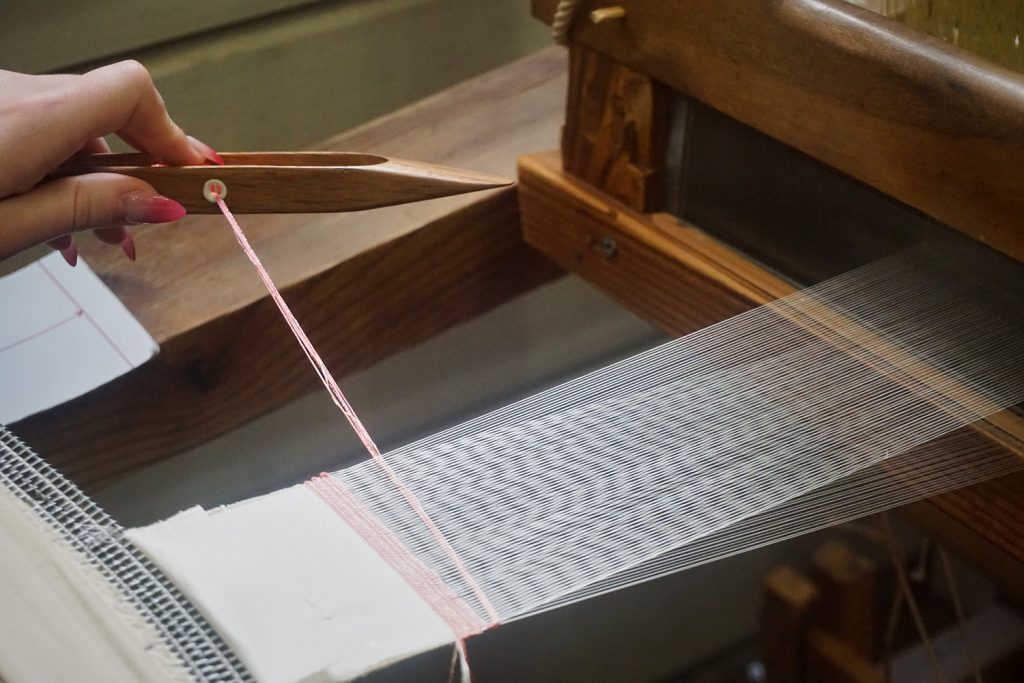
A hand guides a wooden shuttle through the warp threads of a traditional loom at the Koho Nishiki Weaving Workshop.
Text and photo by Katherine Istomin
Bomp, bomp.
Earlier this month, we visited the Koho Nishiki Weaving Workshop, and the rhythmic thud of the loom rang in my head long after the tour. Above the rich history and storytelling, one phrase kept echoing back to me. “Same, but not same,” a message repeated by Minoru Yamada, the vice president of the textile company.
At first, it sounded like a simple explanation of how to look at textile art. Later, I realized it described my own experience in Japan: everything felt familiar and unfamiliar at the same time.
Yamada showed us a tapestry with a wave theme, guiding us from one side to the other to view the different angles of the weaving. He explained that only after looking at the piece from varying perspectives could we enjoy the tapestry holistically.
I came to Kyoto knowing the Japanese culture I had studied in textbooks – the samurai history, the bullet trains and the cherry blossoms. Its tech world filled with fancy toilets and vending machines on every corner. I saw it as a whole picture and didn’t know what to focus on or where to look.
But I changed my view; I took a step toward the right.
Yamada told us that as you shift your perspective, the tapestry reveals more. What first looked flat from the front, changed as you moved from side to side, showing a calm wave. It reminded me of the waves in the Kamo River that I visited many times during my month in Kyoto. A morning run to shake out the first-day nerves; a walk with my friends as we cracked jokes, and I watched our friendship grow; and even the person in the cat costume that plays a saw like a violin each night on the river, ironically reminding me of New York and all of its characters.
I take a left, and suddenly the waves transform into a mountain. It’s the mountain of thousands of torii that my roommate dragged me to climb at six in the morning. And as I stare longer, I see the gold glistening through the rest of the weaving. The relationships I unexpectedly made at the Kyoto University of Foreign Studies, which provided student interpreters for this program. The random coffee shops that we stumbled upon after taking the wrong bus or train. And all the other moments that I hadn’t planned for.
“Just enjoy,” Yamada told us. “Even the Japanese don’t understand sometimes.” Though he was referring to the art, somehow the words hit me a little deeper. It felt like each of those times, even getting lost, was part of the composition. Across the world, with unfamiliar culture and my rather limited Japanese, I finally felt a little less fearful.
When I asked Amane Tatsumura, the owner of the textile workshop, about the machinery, he explained why he kept the old system in place. Not because they can’t update it, but to give each worker a role. He described his role as being an orchestra conductor – taking something that already exists but bringing it together into one whole.
So perhaps I am still learning to conduct my own Kyoto symphony. Not mastering it quite fully, but rather arranging the pieces I’ve collected – the thousand-year-old shrines along with the 7-Elevens, the ancient river beside the student scrolling on its banks, the textile patterns that haven’t changed in centuries running on machines that still go “bomp, bomp.” It’s taking together Japan’s rich history and weaving in all of its contemporary components.
When I began to understand that I was never supposed to decode but rather just to listen and enjoy, I started to notice the beauty and meaning beyond the surface level. Each step left and right revealed something I couldn’t have seen from where I started.
Kyoto was never mine to master. Rather, it was something to witness. In learning to listen, I found that every thread, every step left and right, every unplanned event, was already part of the weave.