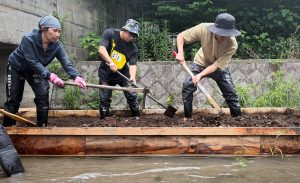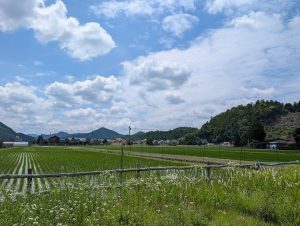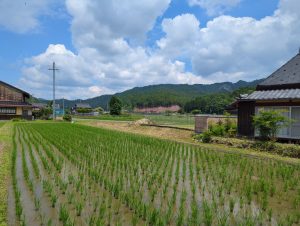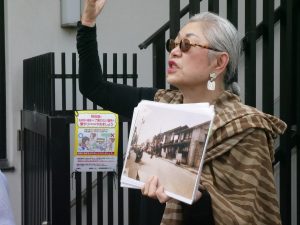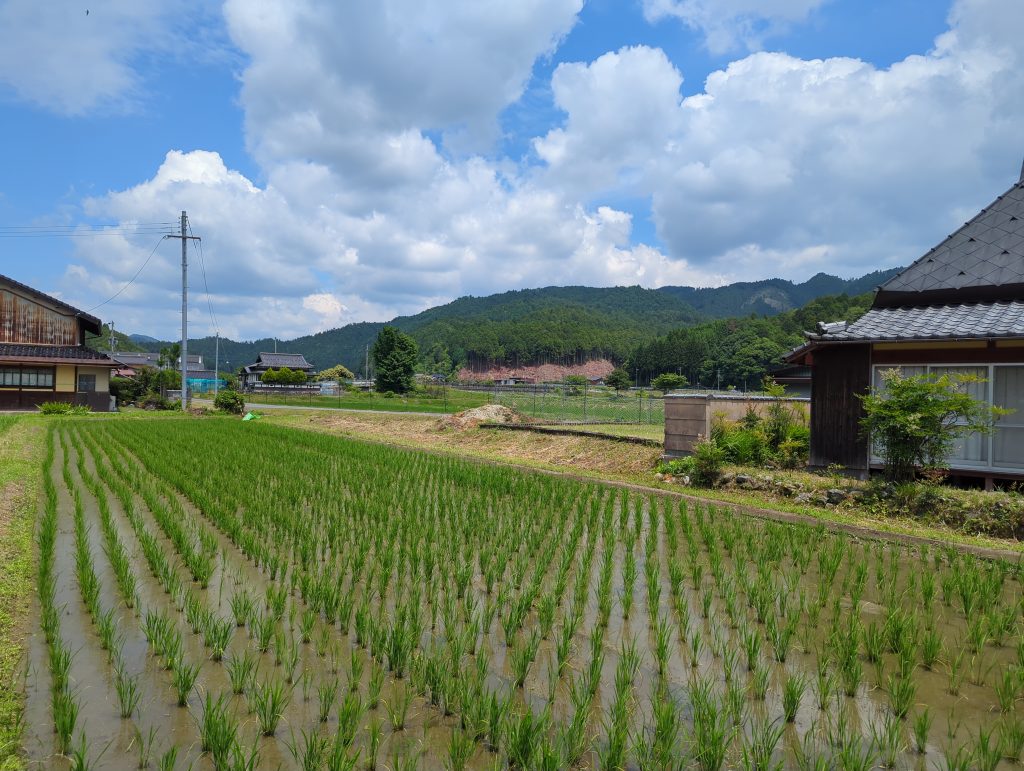
In Keihoku, a declining population of farmers struggles to maintain ancient rice paddies. (Photo by Ben Lyle.)
Text by Ben Lyle
Photos by Ben Lyle and Emma Cooney
Interpretation by Iori Watanabe
Traditional Japanese-style houses, complete with tatami mats for floors, ornate tiled roofs and large sliding paper doors on each side, some lovingly restored, others long since abandoned. Surrounding them, rice fields accessible by narrow roads. Small walkways along miniature aqueducts carrying fresh water from the mountains. On the horizon, forests, both planted and natural, blanket the mountains surrounding the area on all sides. Even just from photographs, Keihoku is a majestic place, and its long history can be immediately felt.
But despite its dreamlike beauty, very few people live in the Keihoku area today. Since its once-formidable timber industry has waned in significance, and the population of rural areas in Japan is declining, this problem has only gotten worse over the decades.
ROOTS, a company founded by a group of relatively new residents of Keihoku, aims to do something about it. Offering guided tours, extended stays in traditional-style Japanese farmhouses, and service projects for students from across the globe, ROOTS aims to build global and domestic connections with the Keihoku area.
They’ve also managed to convince people from their tours and service projects to permanently settle there. Among some of the permanent residents are a surprising number of foreigners, including a French architect and a Taiwanese sculptor. Others have been integrated into the community as habitual visitors.
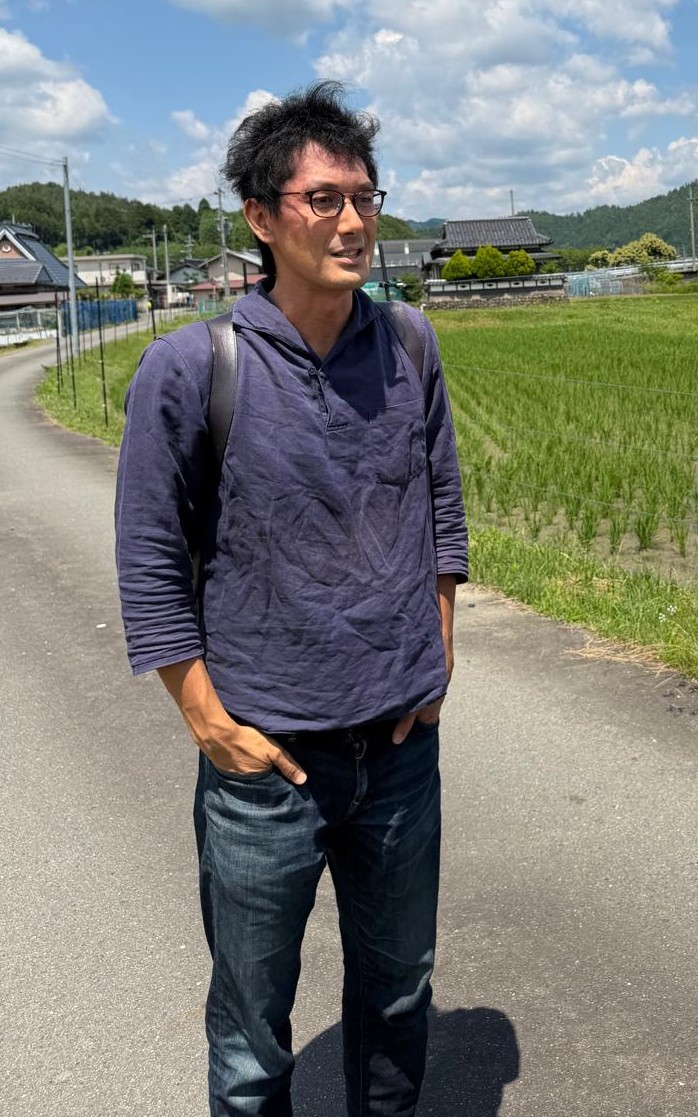
“If you come to Keihoku every week or every month, you are already counted as a partial population of Keihoku,” said ROOTS cofounder Kei Nakayama.
Experiencing Keihoku outside of organizations like ROOTS is rather tough for the curious traveler. Because the community is located deep within the mountains of Kyoto’s Ukyo ward, far outside the bounds of the central city, a private car is about the only way to reliably access it in its entirety. As for public transportation, a bumpy 90-minute ride on the JR Takao Keihoku Kyoto city bus, with limited stops, is your only option.
Lack of travel options to the area shouldn’t come as a shock. In the 1950s the population of Keihoku was around 10,000; now it is down to about a third of that, leading to losses in public transportation and other public services.
“Thirteen years ago when we moved here, the population was 5,600,” Nakayama said. “This year, our population is around 3,800. It’s a huge decline. Every three days, I see a funeral ceremony of somebody I know. So this is not just a figure.”
Akiko Ichise, a 63-year-old long-time resident of Keihoku, works at the Woody Keihoku roadside station, which sells locally grown vegetables and features a small restaurant. She recalls how local schools have been forced to merge as the number of students has dwindled in the time since her children have grown up.
“The numbers are gradually decreasing,” Ichise said. “It’s sad.”
Depopulation in rural areas often goes hand in hand with de-industrialization. Over a millennium ago, Keihoku was settled by lumberjacks who shipped its coveted cedar trees in rafts down the Katsura River, into the Kyoto city center. After World War II, lots of timber was needed to rebuild much of Japan’s recently destroyed industrial base, which the Keihoku area helped supply.
As the timber market globalized, however, it became cheaper to import cedar wood from overseas, greatly reducing the domestic demand, and causing Keihoku’s timber industry to downsize. With fewer jobs, the reasons for people to move elsewhere were strong, and incentives for newcomers to settle in Keihoku became weaker.
Areas suffering from demographic collapse can be found all across the countryside of Japan, and indeed the rest of the industrialized world, whether it be in Europe, Asia or North America, according to “Depopulation globally and in the Asia-Pacific: the shape of things to come” from the February 2026 issue of Fertility and Sterility.
Though ROOTS’ efforts have been focused on a small, sparsely populated region like Keihoku, the city of Kyoto (which annexed Keihoku in 2005) is encouraged by the project.
“This initiative represents a pioneering and distinctive approach to revitalizing the northern mountainous regions and promoting migration,” said Kunimitsu Imai, chief global policy officer of Kyoto City.
ROOTS’ mission is “connecting satoyama wisdom with the world,” as Nakayama puts it. “Simply put, satoyama is this kind of environment, like sustainable settlements where nature and humans exist in harmony or coexist in symbiosis.”

Alongside traditional farming and forestry, a special emphasis is put on maintaining traditional thatched roofs, a particular point of pride for residents. Every 25 to 30 years, these roofs need to be replaced, a laborious task involving harvesting local pampas grass, bundling it tightly together, and skillfully reconstructing the roof with the help of dozens of people. The whole process can take multiple months.
Residents like Ichise have recognized their efforts, even if the overall issue of depopulation remains.
“I’ve seen various people being brought here, and students and others doing activities,” Ichise said. “They promote the beautiful scenery, renovate houses and townhouses, and use them for living or experiencing.”