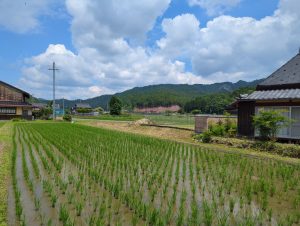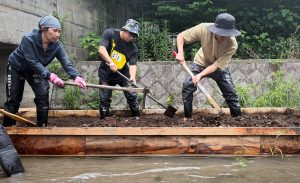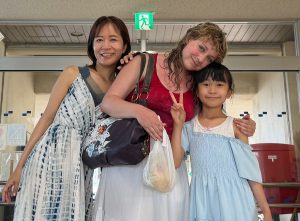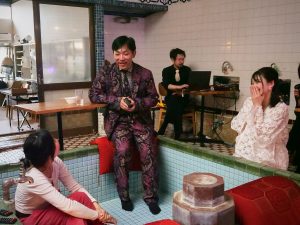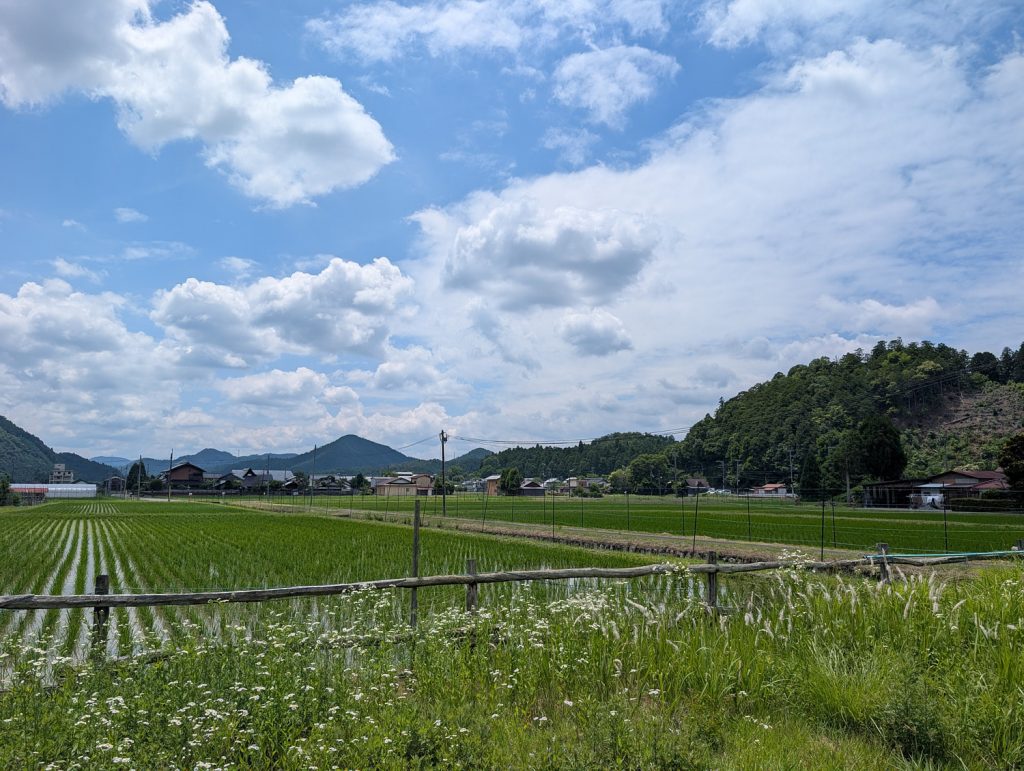
A rice field in the rural community of Keihoku, Japan, is seen in early summer. Many rural communities across the country continue to experience depopulation.
Text and photo by Anthony Clauson
The scent of sawdust permeated the air while the wail of metal on wood spilled out of the small Japanese woodshop.
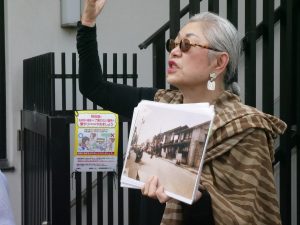
Kei Nakayama, co-founder of the social design and educational tourism company ROOTS in Keihoku, Japan, guided my group of student journalists on a walking tour of the small community. We stood for a moment outside the woodshop, watching through the cracked floor-to-ceiling sliding doors as the men inside hurried about.
As we paused outside the woodshop, memories of Kentucky filled my mind.
The scent of sawdust took me back to days with my dad when we would saw lumber to build a tree house in one of the oaks dotting our Kentucky hilltop property. The whirl of the saw bouncing from wall to wall of the woodshop carried me to my grandfather’s barn. Every day was a new project for a church member or my grandmother, and we would work to the whine of a circular saw and Ritchie Valens’ “La Bamba.”
Since starting college, I don’t often think about the humid days swinging a hammer with my kin. The treehouse is finished, and its boards are warping against nature’s endless advance. My grandparents sold the house, the barn and the land with fresh spring water that I drank by the gallon.
Now I stood on the other side of the world. My hiking boots, conditioned to Kentucky clay, shifted on unfamiliar soil while Nakayama told a story I had heard countless times before. He pointed out a traditional farmhouse and spoke of an old farmer in the village. The farmer had lamented that his sons would never take over the family farm. I was struck by how familiar that story would be between the pews of a small country church or while watching the sun set over a crop of corn. This time, it was uttered between rice paddies and traditional Japanese houses.
Back home, I’ve repeatedly seen the long rows of crops tilled for the final time. The farmers and landowners there, just like in Japan, are getting too old to care for their properties.
Feilang Tseng, a co-CEO of ROOTS, said that on top of a declining population, the local young people no longer feel rooted to their hometowns. These days, she said, youths across Japan feel inclined to move to the city for better job opportunities.
As a young person, I understand the allure of big city lights. I want to be a journalist and chase the biggest stories I can find. Big stories usually hide around big cities. At the same time, I have a family farm I will inherit someday. Unlike the young people Tseng has encountered, however, I am proud of the land my father will pass down to me as his father and his father’s father did before.
As I think about my family’s farm, I see a place to appreciate the ideas taught by Nakayama and Tseng – such as satoyama. Nakayama described satoyama as a “sustainable settlement where nature and humans exist in harmony.”
Satoyama is an idea of harmony between nature and humanity. The concept is native to Japan, but is currently being promoted by the United Nations via the Satoyama Initiative.
The Satoyama Initiative “aims to build on mutually beneficial human-nature relationships, where the maintenance and development of socio-economic activities (including agriculture, fishing and forestry) aligns with natural processes,” according to the initiative’s website.
In Kentucky, satoyama lives in firewood. My family and I often stayed in a small cabin my dad built before I was born. There is no electricity there, so we used a wood stove for heat. Countless times, we’d find a fallen tree. We would dissect it and harvest the lumber, chopping it into usable pieces with a saw and an axe. At night, I felt the warmth the wood provided as its gentle popping joined the symphony of cricket songs and coyote yips.
The wood provided us with warmth, and by clearing the debris of a fallen tree, we made room for the other plants to grow and tended to the trails we shared with the deer.
Satoyama is about learning to appreciate the small ways humanity and nature can care for each other. While the four generations who have tended my family’s land pale in comparison to the centuries of history on Japanese soil, a Japanese village isn’t all that different from a Kentucky holler.
No matter where I roam, the sun will scorch the grass the same way. Rivers will roll over rocks the same way. Spring water will taste the same. And sawdust will always smell like home.