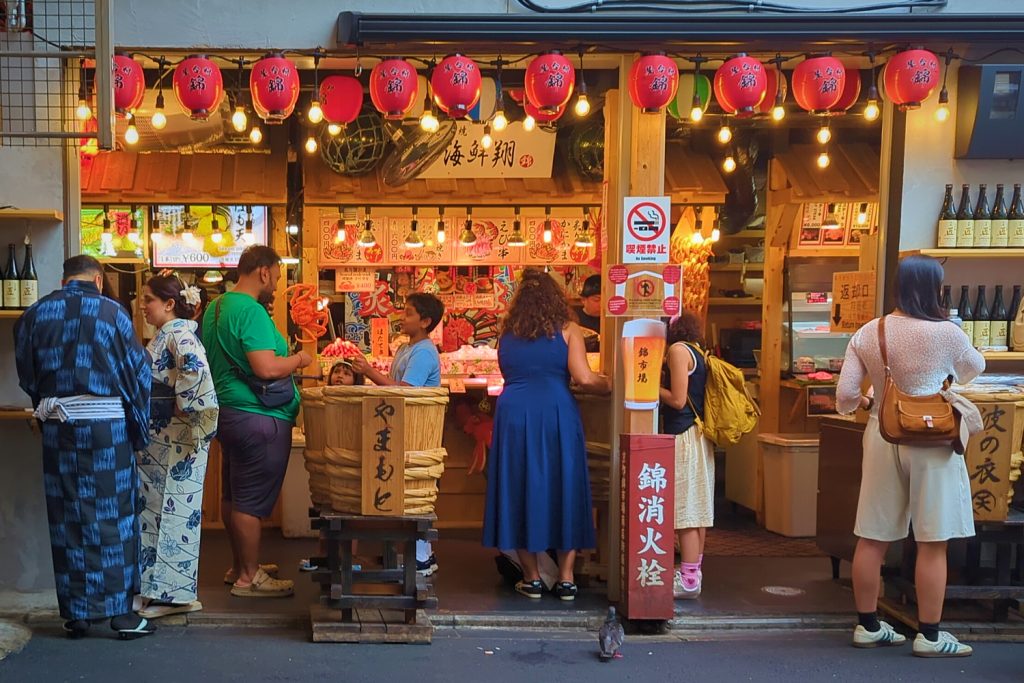
Tourists crowd into a Nishiki Market stall. Many feel pressure to buy something, but rarely converse with the locals they meet. (Photo by Ben Lyle.)
Text and photos by Ben Lyle
Once you’re here, it’s pretty clear why 60 million people visit Kyoto every year. I could visit Kyoto every summer for the rest of my life and still not have enough time to see everything the city has to offer. With seven UNESCO World Heritage Sites, along with popular tourist attractions like the Arashiyama area and its bamboo forest, and buildings over 200 years old — many of them tucked into an alleyway of an unassuming street — Kyoto has endless sights to offer.
Upon my second visit to the city, however, a familiar feeling of emptiness came back to me. The feeling that I wasn’t really connecting with the city and its people, merely consuming for my own gluttonous appetite, became clear to me. So many magnificent, beautiful places, yet with a press of a button on my smartphone, a memory is saved to my phone’s storage, and I am on my way to the next site. Time passes, and the place I just visited becomes fuzzy and unclear. I know I visited Kiyomizu-dera and Fushimi Inari Taisha because I scrolled past them on my phone, but these photos barely jog my memory. Is it right to say I’ve been there if I need a picture to “remember” being there?
The word consumption stuck with me, as this is how it’s always been since I have been able to travel. Whether it be Yosemite in the United States or Kyoto, Japan, I am a consumer. That is what is encouraged, after all, not only by the millions of social media pictures, but also in large part by the people who manage these places. They are selling a product that I am buying.
I began to wonder if it was possible to break this cycle of consumption, to visit a place and feel something more than the temporary high I’m used to. That’s when I came to understand the importance of the humans that surround me, whether they be locals or fellow travelers.
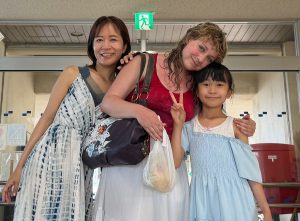
The sight of a magnificent building or natural formation may or may not stick with me, but a connection with another human being, no matter how insignificant, will. It’s why I can remember talking to the train station employee as she kindly and patiently walked me through what I had to do to buy a ticket. I had a similar experience when I bought a camera, awkwardly using my limited language skills to get details on what I was buying, and was complimented on my Japanese. Ironically, I remember the layout of that particular train station and its tall glass ceilings, and that small camera store tucked into the side of an eight-story department store, better than many of the famous tourist destinations I have saved on my camera.
Realistically, I will probably continue being a “tourist” in the ways listed above. It’s not like I can always predict when these kinds of memorable human interactions occur, and the culture we live in encourages this type of sightseeing. I will, however, do better at interacting with the people who live in these places. Even if it’s awkward and we can’t fully communicate, treating people like human beings, acknowledging their existence, will inevitably lead them to acknowledge our existence. That, in my view, is what makes it feel like I’ve truly been somewhere.