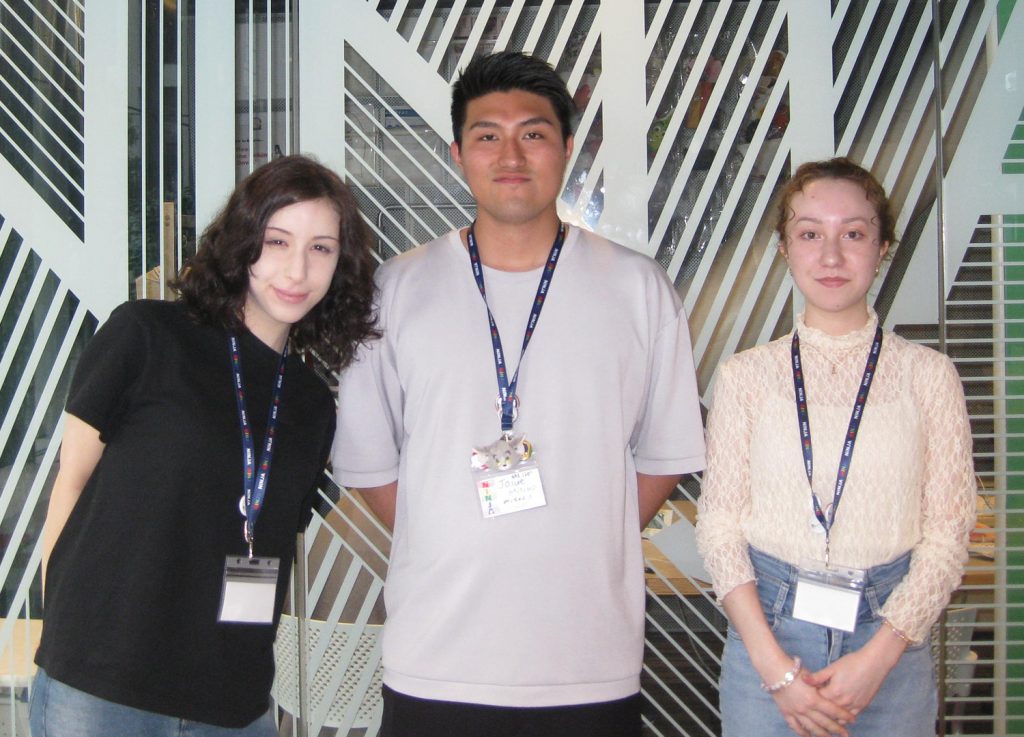
Immigrant students find community at Navigating an Independent Non-stop Journey to Autonomy. From left, Elkeek Kamal Mirvat, Josue Mitsuo Oikawa Melendez and Beatriz Saito.
Text and photo by Aya Fisher
Born in Brazil, Beatriz Saito has lived in Japan since she was 5 years old. When asked if Japan felt like home, the 22-year-old economics student at Kyoto University of Foreign Studies answered with two simple words: “Not really.”
Coming to live in Japan from another country poses challenges, as well as opportunities. In interviews with ieiMedia, three students born outside the country shared varying perspectives on what it means to be home. Even though these three students’ stories are different from each other, they have all found something in common through a program at KUFS called Navigating an Independent Non-stop Journey to Autonomy, better known on campus as NINJA. The program brings together students with different backgrounds on campus to practice languages and share cultures.
Despite living in Japan for so long, Saito said she still does not fully feel like she belongs.
Japan feels safe and familiar, and it’s where her family lives, but growing up wasn’t easy. “Japanese society really encourages people to be monocultural,” she said. “Everyone follows a certain path.”
Elementary school was the hardest. She remembered feeling different from other students and experiencing discrimination at a very young age. Even though those moments were difficult, she had fewer bad experiences as she got older.
Adjusting to life in Japan also meant getting used to everyday small changes. At home, Beatriz ate Brazilian food, but once she started elementary school, every lunch became Japanese food. It took time to adjust, but now she loves most Japanese food.
Beatriz still appreciates many thing about living in Japan. When asked to describe Japan in one word, Beatriz chose “tradition.” “Japanese people are very conservative,” she said. “They value tradition.”
Even though Japan has been her home for most of her life, she hopes to study abroad one day because she wants to experience other countries and continue to discover more.
Josue Mitsuo Oikawa Melendez, 21, has had a different experience.
Born and raised in Japan to a Japanese Brazilian father and a Peruvian mother, Melendez said he has never really questioned who he is. “The only time I think about it is when I have to fill out documents asking about my nationality,” he said.
For him, the biggest challenge has been adjusting to different beliefs and values. As a Christian, Melendez said, he sometimes feels he has different beliefs than those around him in Japan, but he still appreciates the kindness and hospitality of people here.
When asked what he loves the most about living in Japan, he immediately mentioned the people. “They have hospitality,” he said. “They try to understand different cultures.”
If he had to describe Japan in one word, it would be tamashii, which means soul or spirit. For Melendez, that word represents the passion Japanese people have for their goals and their curiosity about learning other cultures.
While Saito and Melendez grew up in Japan, Kamal Mirvatte Errkik’s story is different. Originally from France, the 20-year-old moved to Japan almost three years ago after graduating from high school.
She had always loved Japanese culture through anime, music, fashion and the language. But another reason she came was that she never truly felt at home in France. “I never felt fully at home in France, even when speaking French, I felt more at ease speaking Japanese.”
When Errkik first moved to Japan, she thought changing countries would help her feel more at home. Instead, she realized belonging was not that simple.
Living in Japan was different from what she expected based on what she had seen online. Learning about Japanese culture from outside the country was not the same as living in it every day. Some of her expectations were not met, but that never made her want to leave. It made her want to adjust more and learn more about the culture.
What she loves about Japan is not just one thing but “a package of a lot of things like nightlife, people, language, and food.”
When asked to describe Japan in one word, she chose “magnificent.” “There are always things that you don’t know about Japan,” she said. “Even walking down the street, you see a lot of different things.”
Errkik has also experienced discrimination, especially while working in bars where some customers were rude to her or did not want her to serve them. But she said it does not happen all the time, and she tries to understand that it comes from people not understanding someone from a different background.
She said some people are not used to her at first, but when she shares her story and shows that she knows the culture and speaks Japanese, they become more accepting. “I never really felt at home,” she said. “But I feel at peace.”
Like Melendez and Saito, Errkik said NINJA has given her a community on campus where she is celebrated and welcomed. “Even when you change countries, it won’t mean you will feel at home,” she said. “You need to find that inside yourself.”